
INFOSHEET MASTHEAD RIG
The masthead rig is recognizable by identifying that the forestay goes ALL the way to the very top of the mast. Masthead rig is the rig for all the Catalina based boats, the Jaguars 22, 25 & the 27.
Whilst this infosheet seeks to provide information to help set up & tune a masthead rig, it should be remembered that all bottle screws should be clean & oiled/greased. They should not be sealed with tape as this holds in damp. They and the deck fittings should be in line, & the rigging sound. If you don’t know when the rigging was last changed: change it.
The initial goal in setting a masthead rig is that the mast should initially at least be plumb, both laterally & fore & aft. Because of this, the rig is adjusted top down. To ascertain whether the mast is plumb, secure a halyard so it JUST touches the base of a cap shroud. It should then do the same on the opposite side. However, first, all the shrouds are loosely attached: sight up the mast (look up the sail track) & see that the mast itself has no bends of its own. If it has, this needs investigating before proceeding. We will assume here that all is as it should be….
Ensuring that the mast is plumb (adjustments are done by tightening the bottle screw on one cap shroud & easing its opposite), evenly tighten all the shrouds by hand: EXcluding the fore & aft lowers, we are only concerned with the fore & aft shrouds, (also known as the fore & back stays) & the cap shrouds for the moment. Another check & tighten by a further 2-4 turns. Walk away, as far as practicable, and sight the mast again.
The fore & after shrouds or stays are done in the same way, noting that some backstays may be split, but the mast should be raked aft by no more than the masts longitudinal width, over its entire length. This can be measured by putting a weight on the main halyard, & it should hang at the masts base, about 4-6” away. If later sea trials you end up with lee helm in 10 knots of wind, try a little more rake to the mast. Tighten up in the same way as the cap shrouds, noting that the forestay (once all is set) is tightened by tensioning the backstay.
Now let’s look at the lowers; there’s a pair of forward lowers, & a pair of aft lowers that sprout from just below the spreaders. However it should be noted that the rig on the Jaguar 25 Mk2 has a baby stay instead of the forward pair of lowers, which it replaces. In effect, the baby stay (from the front of the mast, below the spreaders to the coach roof by the hatch) does the job of both the forward lowers.
The lowers (or the baby stay) should be tightened evenly, by hand, as was first done with all the other shrouds. The job of the lowers, as well as also securing the mast, is to allow a little pre-bend (forwards) in the mast. (They can also remove any athwartship bends in the mast) This should not be confused with the bend in some whippy fractionally rigged yachts, it will be no more than the longitudinal width of the mast, say 4-6”, & will be at the point where the shrouds meet the mast (spreader height). This is done by tensioning the forward lowers/baby stay against the aft lowers, & the backstay, AFTER they have all been tightened, by a further 2-4 turns as with the other shrouds.
With that, all should be done, have a good check round, is the mast plumb; is there just a little rake overall; is there just a little pre-bend, introduced at the height of the spreaders? Are the spreaders set correctly? The angle at their ends should bisect the cap shroud: therefore they will be angled upwards. This is important, too many boats can be seen with drooping spreaders, & it is asking for the mast to come down!
All that remains, before locking off/wiring up the bottle screws, is to go for a little sail, ideally in conditions that are towards the top end of carrying full sail, a nice F3 perhaps? Sail to windward, noting if any leeward shrouds are “floppy slack”, tack, & check the others. Note that the leeward shroud should just go slack, no more. Tighten the slack shroud, then tack & check its opposite. If your forestay is too slack, & the luff of the genoa is falling away (compromising pointing ability), then tighten the backstay(s). It is very difficult to overtighten shrouds, but if you find that you are constantly having to tighten them to maintain tension, particularly the fore & aft shrouds, then it suggests that something is wrong with the integrity of the boat. Do though remember that new rigging will stretch a little in the first couple of seasons.
When you’re happy then lock everything off. If using monel seizing wire, cut it so its ends are in the bottle screw, & tape just that bit, with self amalgamating tape & not electrical insulation tape.
*Please note that this sheet is designed as a guidance tool only. Manuals are available for some models through the Jaguar Owners Association. If you are in any doubt, seek further advice or help; boatyards & sailmakers are FULL of good advice, readily & freely given, as is the JOA website message board, which has unlimited free access. No liability will be accepted by the author or the Jaguar Owners Association.
www.jaguar-yachts.info
Laurie Milton Jaguar Owners Association
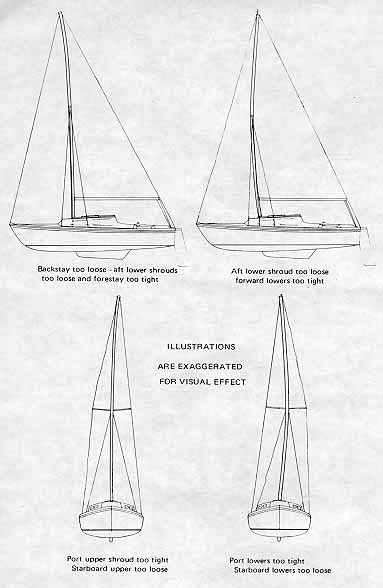
Illustration from J22 manual showing the effect of shroud tension on the shape of the mast